Here’s the truth:
Most UK small businesses are drowning in marketing challenges they never saw coming.
You’ve got a great product. You work harder than your competitors. But they’re getting the customers while your marketing budget disappears with nothing to show for it.
Sound familiar?
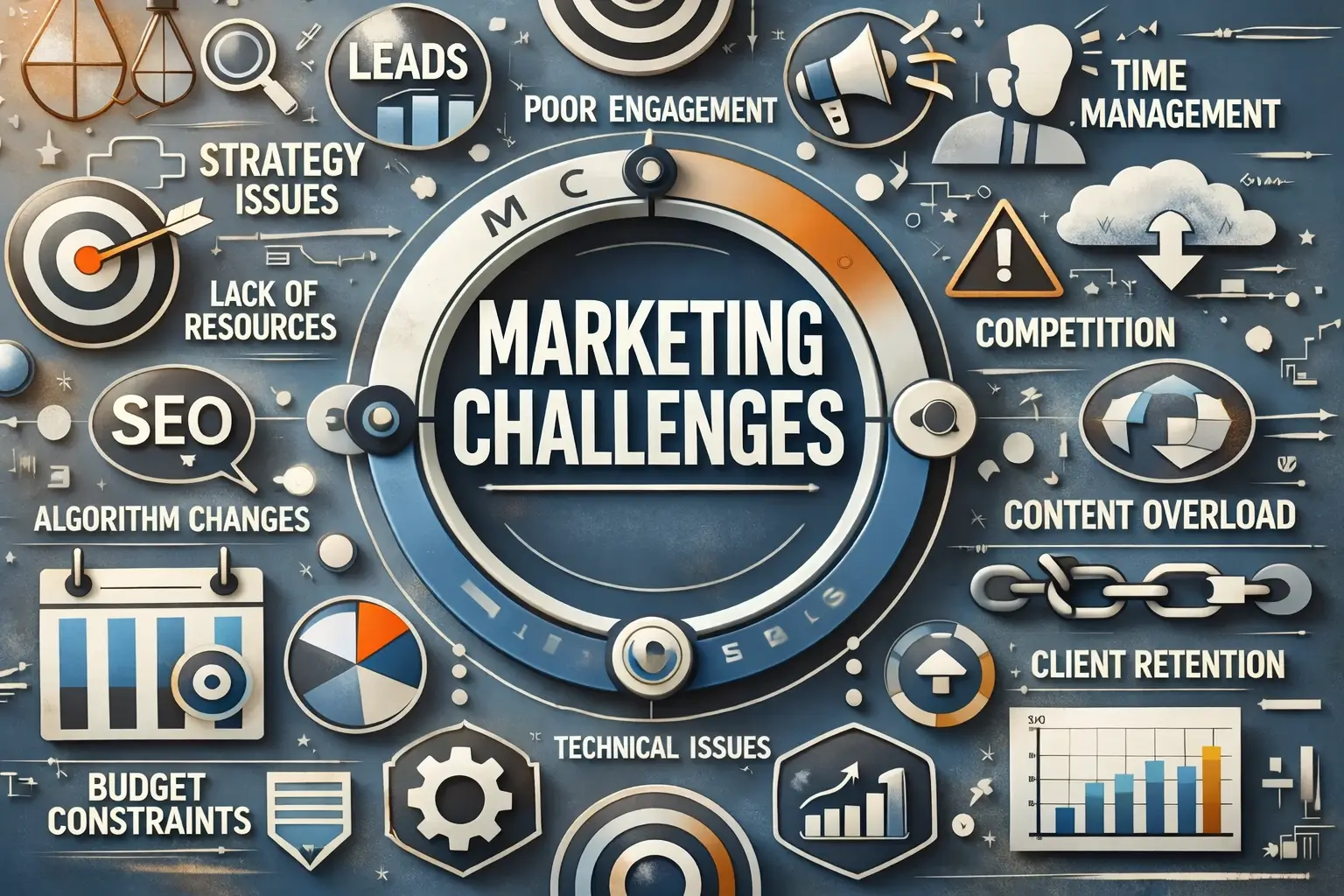
52% of UK businesses say budget is their biggest marketing barrier. 51% struggle with time management. And keeping up with trends? Nearly impossible.
This article is different. No tired advice about “post more on social media” or “just run ads.” Instead, you’ll get marketing solutions that actually work when you’re running on fumes, tactics that deliver results without a corporate budget.
Let’s dig into the three biggest marketing challenges for small businesses in the UK and, most importantly, how to fix them without spending a fortune.
Challenge #1:
Market like a big brand, but with a corner shop budget.
Let’s start with the elephant in the room: money. Or more accurately, the lack of it.
UK small businesses are being told they need to run Facebook ads, Google ads, LinkedIn campaigns, influencer partnerships, email automation, SEO content, and video marketing. all at the same time.
The problem?
You’ve got £500 a month (if you’re lucky) and every ad platform is eating that alive before you see a single lead.
Ads are getting more expensive, so you’re paying more but getting fewer results. Clicks on Google and Facebook cost a lot now. If you don’t have a big budget, it’s hard to compete.
The big companies with huge budgets are fine. You’re left wondering how to get customers with a small budget while competitors with more money dominate the market.
How to Market with No Budget UK:
If you’re thinking, ‘Great, so I’m screwed,’ stop. Some of the smartest marketers in the UK are proving that you can build serious momentum without spending a penny on ads.
Here’s how:
1. Master organic content on one platform (not five).
Pick the platform where your ideal customers actually spend time: LinkedIn for B2B, Instagram for lifestyle brands, and TikTok for younger audiences. Post valuable content 4–5 times per week. Not promotional rubbish. Actual value. Share case studies, answer common questions, and engage in comments like your business depends on it (because it does).
2. Build a referral system that runs on autopilot.
50% of small businesses say referrals are their best customer source. Ask happy customers for referrals. Make it dead simple: send a templated message, offer a small incentive (discount, freebie, coffee), and turn one customer into three.
3. Collaborate with non-competing local businesses.
Partner with businesses that serve the same customers but don’t compete with you. Cross-promote each other’s services. Co-host an event. Share each other’s content. Free exposure, zero ad spend.
4. Own your Google Business Profile like it’s your shopfront.
This is digital marketing on a tight budget. Optimise it completely: photos, hours, services, posts, reviews. Encourage every customer to leave a review. Local searches drive foot traffic and leads, and it costs nothing.
5. Use email marketing like your business depends on it.
Email has the highest ROI (return on investment) of any marketing channel, £42 for every £1 spent. Collect emails at every touchpoint (checkout, events, website), send weekly value-driven emails, and watch conversions roll in. Tools like Mailchimp are free for up to 500 contacts.
Challenge #2:
You’re Running Your Business AND Trying to Be a Full-Time Marketer
Even if money wasn’t an issue, there’s still one resource you can’t buy more of: time.
You’re already managing operations, dealing with suppliers, handling customer service, doing the bookkeeping, and somehow trying to find time to market your business.
The reality?
Marketing ends up being the thing you do ‘when you get a chance’ which means it never gets done properly.
51% of UK businesses list time management for marketing teams as a top challenge. Marketing isn’t one task; it’s dozens. Content creation, scheduling, engagement, analytics, campaign optimisation… It’s a full-time job pretending to be a side project.
The result?
Rushed campaigns. Inconsistent posting. Half-finished ideas. And a nagging feeling that you should be doing more, even though there’s literally no time left in the day.
Time Management for Marketing Teams (of One)
If you’re a solo marketer or a small team, time is your most valuable asset. Here’s how to get marketing done without burning out:
6. Batch your content creation.
Set aside 3 hours once a week to create all your content in one sitting. Write 4 LinkedIn posts, script 3 short videos, and design 5 Instagram graphics. Then schedule them using free tools like Buffer or Hootsuite. You’ve just handled a month of content in one session.
7. Repurpose everything ruthlessly.
One blog post becomes 5 LinkedIn posts, 10 tweets, an email, and a carousel. One video becomes 3 short clips. One customer testimonial becomes a case study, a social post, and website copy. Stop creating new content from scratch every time.
8. Automate the repetitive stuff.
Use Zapier to connect your tools. Automate email follow-ups, social media scheduling, and lead capture. Set up templates for everything: emails, proposals, and social captions. The less you reinvent the wheel, the more time you save.
9. Set strict marketing hours.
Marketing expands to fill the time you give it. Block out 2 hours a day maximum. Focus only on high-impact activities (posting, engaging, email). Everything else is noise.
Challenge #3:
Marketing Trends Change Faster Than You Can Keep Up
Every week, there’s something new. AI search. TikTok SEO. Instagram algorithm changes. Google’s Core Updates. LinkedIn’s new features. The pressure to stay current is relentless.
36% of UK businesses say keeping up with marketing trends UK small business owners face is one of their top three challenges. And it’s not hard to see why. What worked six months ago is dead now.
You’re constantly feeling like you’re one step behind, watching competitors adopt new tactics while you’re still trying to figure out the basics.
The fear?
Fall too far behind, and you become irrelevant. But trying to chase every trend? That’s a fast track to burnout and wasted effort.
UK Small Business Marketing Tips 2026: What to Ignore and What to Double Down On
Not every trend deserves your attention. Here’s how to separate signal from noise:
10. Follow the 80/20 rule ruthlessly.
80% of your results come from 20% of your efforts. Identify your 1–2 highest-performing marketing channels and double down. Ignore the rest. If LinkedIn is driving leads, pour your energy there. Don’t dilute your focus chasing TikTok just because everyone says you should.
11. Test trends on a small scale first.
Heard about AI-generated content? Test it for 2 weeks. New Instagram feature? Try it for 10 posts. If it works, scale. If not, move on. Never commit fully to unproven tactics.
12. Subscribe to one trusted source.
Pick one reliable newsletter or podcast that covers UK marketing trends (Marketing Week, Smart Insights, or similar). Spend 30 minutes a week staying informed. That’s it. Don’t fall into the rabbit hole of consuming endless content.
13. Focus on fundamentals, not fads.
Good copywriting, understanding your customer, building trust, delivering value these never go out of style. Trends come and go. Fundamentals win in the long term.
14. Watch your competitors, but don’t copy them blindly.
If a competitor is crushing it on a platform, investigate. But don’t assume it’ll work for you. They have a bigger budget, a different audience, or just got lucky. Learn from them, but stay in your lane.
The Real Talk: Marketing Solutions for Small Businesses That Work
Here’s what separates the UK small businesses that thrive from the ones that struggle:
They don’t try to do everything. Pick 2–3 marketing activities and do them exceptionally well. Focus on ROI (return on investment) marketing strategies, not vanity metrics. They track what works (cost per lead, conversion rate, customer lifetime value) and kill what doesn’t.
They understand that consistency beats perfection. A decent post published every week beats a ‘perfect’ post published once a month. Show up. Be useful. Build trust. That’s how you win.
They stop trying to compete with big brands on their terms. Instead, they leverage their biggest advantage: being small, nimble, and personal. They build real relationships, engage directly with customers, move fast, and adapt quickly.
Frequently Asked Questions
1. What are the marketing challenges UK small businesses face?
Many small business owners struggle with rising ad costs, lack of time, and constantly changing trends, making it hard to attract customers and grow online without a clear strategy.
2. How can I market my small business effectively without a big budget?
You can focus on organic content, local SEO, email marketing, customer referrals, and collaborations with local businesses, all strategies that deliver results without heavy ad spend.
3. Why isn’t my marketing working, and what should I do first?
Often, marketing fails because of unclear messaging, unfocused campaigns, or not knowing your ideal customer. Start by defining your audience and clarifying your core message before scaling.
4. What marketing channels should a UK small business focus on?
Small businesses usually get better results by focusing on a few channels where their customers spend time, like LinkedIn for B2B, Instagram for lifestyle brands, or prioritising local search rather than trying everything at once.
How can BizGrow Digital assist businesses with marketing challenges?
The marketing hurdles UK small businesses face in 2026 are tight budgets, limited time, and constant change. BizGrow Digital helps you overcome these challenges without needing a massive budget or full-time team.
We provide clear strategies that focus on what works, guide you to stay consistent, track results, and optimise campaigns effectively.
By starting small, focusing on one channel, and leveraging our expertise, businesses can build momentum, attract customers, and thrive even with limited resources.
That’s how UK small businesses stay competitive and grow with confidence.